Sunday, 15 March 2020

one flower in Trifolii - video, music and link


get to TRIFOLII - newbie, freebies and REZ area


Music by Ilya Truhanov from Fugue
on the road
thanks to https://icons8.com/

and by Nat Keefe & Hot Buttered Rum
Cats Searching for the Truth


The distance meter that the whole world envies us


The distance meter that the whole world envies us


#SecondLife to expand support & reduce prices for


17:03 / 17:22 DIY Tool that Built the Pyramids


Saturday, 14 March 2020

Sing that will pass". The Italy of social calls and deserted neighborhoods are lit up through thousands of people who meet outside the balconies:

Sing that will pass". The Italy of social calls and deserted neighborhoods are lit up through thousands of people who meet outside the balconies: they sing songs and share hours of sociality despite the isolation of the country. From North to South, all strictly locked in the house, but still together. And with music as therapy against the fear of Covid-19. So in Palermo there is also those who thought to animate the evening by improvising a DJ-set on the balcony of the house, with a professional console, making the whole neighborhood dance.


Friday, 13 March 2020

METAL GEODETIC DOME


OUTSIDE THERE IS one of MY METAL GEODETIC DOMEs (differents from the wood ones) while outside there is a new gift that I got from NLS:
T-80 Addon: Liberator Crew Room


nearby there was a bombing jesus that I do not know if it is amusing or horrible, as I am atheist but I should respect other people believes


MUSIC BY
Lobo Loco - Jessy Travel Gambler

this dome is a tribute to wonderful Vroum Short and I used the textures I got from her vegetal planet


all my vegetal planet posts:


here you can found photos of an other metal dome, with a glass room inside, a bloody ball around and a couple of clouds in the water   


NLS PROBLEMS FOLLOWS

i GOT A PROBLEM WITH AN NLS PRODUCT THAT i RECEIVED AS A GIFT A LONG TIME AGO AS i CANNOT DEMONSTRATE IT WAS A GIFT AND THE PERSON IN CHARGE IN THE ASSISTANCE GROUP DOES NOT HELP ME

YOU CAN READ THE CONVERSATION IN MY PREVIOUS POST: 
https://free-libbberamente.blogspot.com/2020/03/nls.html

TODAY I RECEIVED AN OTHER GIFT FROM NLS (THIS IS WORKING :-) AND NOW I RECORD HERE THE HAPPENING THAT DO NOT DEMONSTRATE NOTHING AS i COULD WRITE IT MYSELF, BUT IT IS BETTER THEN NOTHING... AT LEAST ONE CAN SEE THAT PRESENT COME FROM THEM AND WHO KNOW IF IT IS RECORDED IN THE caspervend PAGE!!!

"[08:22] Second Life: Sweet Baby - Daily Prize Board 2.0 owned by NLS (newlondonsystems) gave you 'T-80 Addon: Liberator Crew Room'  ( Cool Atoll (42,32,31) ).

[08:26] T-80 Addon: Liberator Crew Room: Hello, and thank you for purchasing this NLS product. The packaging will self destruct in 1 minute.
[08:27] T-80 Addon: Liberator Crew Room whispers: Goodbye cruel world!
[08:27] nls Addon: Liberator Crew Room: Welcome to HORIZONS! Please click REZ on the menu or pickup this crate and install it in a Horizons-compatible system.
[08:27] Crew Door 1: Left click the Door to use it. Admins left click it and hold mouse down for over 5 seconds for config menu.
[08:27] Crew Door 1: Left click the Door to use it. Admins left click it and hold mouse down for over 5 seconds for config menu.
[08:28] Second Life: nls Addon: Liberator Crew Room [REZZED] owned by free... (libbberamente) gave you 'About HORIZONS'  ( Plissco (42,207,44) ).
[08:30] Crew Door 1: ."

NOW I AM GOING TO CHECK THE MATTER AND MAKE AN INFO FOR SL... 

NOTHING IN THIS PAGE WILL BE MODIFY (FROM ME, AT LEAST)...


I CHECKED THE CASPERVEND PAGE:
- THERE IS THE HUD I BOUGHT DURING THE CONVERSATION WITH THE NLS GROUP BUT THERE IS NOT THE GIFT I GOT TODAY


MAKKOX IN ENGLISH!!! - SMART WORKING


WELL.. AS FOR US, THIS POSSIBILITY OF SMART WORKING FROM HOME, WE TAKE IT IN THE A..


I have the author's permission 
to devastate his work.
if someone  feel the urge to help 
is welcome (very)...


MAKKOX IN ENGLISH!!! - PANCROMIA


THAT?...
IT IS EARTH: THE RED PLANET

MAKKOX - PANCROMIA


I have the author's permission 
to devastate his work.
if someone  feel the urge to help 
is welcome (very)...


figure it out for themselves - Luca Sofri - Wittgenstein - Ilpost.it

figure it out for themselves
  Luca Sofri 
Wittgenstein 
 Ilpost.it


11 Mars 2020


A few years ago, during an American holiday with my family, my son Ludovico was very intrigued by the discovery of the honor system, which was illustrated by a friend who lives in Seattle. We had come across a discount in a museum for those who prove to have come by bike, showing the bike helmet. And Ludovico had prudently asked: "how do they know that one did not wear the helmet only for the discount, and came in the car?". So our friend Diego explained the honor system to him.

"An honor system or honesty system is a philosophical way of running a Variety of Endeavors based on trust, honor, and honesty. Something that operates under the rule of the "honor system" is usually something that does not have strictly enforced rules governing its principles.
The honor system is also a system granting freedom from customary surveillance (as to students or prisoners) with the understanding that those who are so freed will be bound by their honor to observe Regulations (e.g. prison farms are operated under the honor system), and will therefore not abuse the trust placed in them.
A person engaged in an honor system has a strong negative concept of breaking or going against it. The negatives may include community shame, loss of status, loss of a personal sense of integrity and pride or in extreme situations, banishment from one’s community."

Unfortunately, we would have liked to have done without it, but the government decrees on the coronavirus and their formulations on behavioural and travel restrictions are an interesting laboratory of reflection on the balance between education and repression, but also more extensively on the State’s interference in people’s autonomous choices, on citizens' ability to "look after themselves" and on many other concepts that have always been discussed with many contradictions (think of those right-wing people who want at the same time more freedom from the state and more control of the state). And finally, they generate reflections on the education of citizens, on the information, on the cultural work to be done to improve the functioning of a community and a country.


A confident and constructive reading of the decrees we are talking about can in fact consider them as such: they are a measured attempt to suggest to people a gravity of the situation and a need for sacrifices that had hitherto been underestimated, without recourse to explicit prohibitions, restrictions on freedom, authoritarian and repressive approaches. Despite the widespread use of the term these days, those rules are not "prohibitions" and the Count himself at the press conference was careful not to call them so, with balanced but revealing formulations of this attempt.

"there will be the constraint to avoid any displacement

we do not have a total ban on transfer, but there is a need to motivate it, and therefore certainly there is a reduced mobilitywe must all be more responsible"
The same decree distinguishes between the formulas of "absolute prohibition of mobility" intended for the infected and that "avoiding any movement" for all the others.


And being excluded also in practice that the observance of the demands of the decree can be managed in a police and systematic way, I think that the idea, sensible, was: we raise the voice and ask for help at the same time, we scare and responsibility at the same time. Let us rely on– once the dangers are cleared–to the understanding and conscience of people, but this cannot be enough without the deterrent of sanctions for those who have not understood even now. A right balance– in my opinion– of education and repression, in which the first always prevails and allows there to be no overpowering of an authoritarian state with respect to the autonomy of judgment and freedom of persons.


After this encouraging reading, however, three problems arose. I count three, at least.


The first is a formal and substantial contradiction: on the one hand there is the communication that there are no absolute prohibitions, the relying on a part of common sense and interpretation ("of course you can go shopping"), the hint that the various cases of "necessity" – obviously very ambiguous and elastic term– they are delegated to the judgement of the individuals; on the other hand there is the explicit call to sanctions and defined criminal consequences. And you understand that it is difficult for people to feel serene about their autonomy of judgment and common sense if at the same time something says to them "if you fail in judgment, we will put you in jail". It’s the honor system of one of its founding halves.

Tell me exactly what I can do and what I can’t.


And here is the second problem: that in such an unprecedented state intervention situation to overturn common and customary behaviors, to regulate exactly what can and cannot be done is practically impossible. The most diverse eventualities are manifesting themselves right after the announcement of the rules, many unforeseen events. I am not a lawyer, but it could be the decree with the highest relationship between its brevity and the field of occasions to which it applies: field summarized in "lives". Of 60 million people. These days even the Post– and I imagine even more the major newspapers– receives frequent requests for explanation on very singular (and often poignant) cases of people with the most diverse and delicate needs and problems. "Can I do this?" we all ask ourselves several times every day. And we have all already imagined great and small "normative voids", sometimes insignificant but other times very significant and dramatic. A greater example of all concerns families that for one reason or another (the separated, for example) do not live continuously and permanently together: simply wanting to see oneself, is in those cases a "necessity"? (Of course it is, I say: but I decide, it is not written or said anywhere). Not to mention the simple romantic relationships of non-cohabitants.

It is true, as some complain, that the instructions are vague and sometimes frightening. It is also true that they are instructions that are trying to do something that has never been done, and perhaps you can not do so much better than this– adding gradually more clarity, and "to understand" – remaining a democratic country, libertarian and with a Constitution.


The third problem is related to this, but it has a whole history, and it is the biggest and most enlightening problem of the functioning of the country, in my opinion: that precedes and will follow this emergency. The honor system, or any even more moderate and controlled investment in citizens' responsibility and awareness, needs citizens' awareness. Many, in recent days, have rather called for severe, authoritarian and repressive interventions, after observing the lightness with which a part of the population was reacting to requests for prudence. And the feeling is that often we ourselves need "orders", not instructions: many of us struggle to appropriate the responsibility to decide for the best, feel disoriented, fear to do the wrong thing. They want "orders" and someone to give them to them.

It is partly human and understandable, but it has also increased extraordinarily from the low level of information and culture that we receive. Being responsible, conscious, autonomous in reasonable and conscientious judgment is the result of knowing things, understanding them, being informed of them, as well as being educated in the sense and functioning of a community (and perhaps also to the understanding and methods of science). "to understand it alone" is the result of a political and cultural work that is now more weakened than ever. The rituals and secular comments about Italians who need to be commanded are once again the overflow towards the repression of something that should be left to education: Italians– we– need to be educated, or educate themselves if you prefer (on the meaning of educating and the sensibilities that collide here); it is not by chance that the honor system is widespread in countries where the investment in civic education, education and correct information has always been greater.


Maybe we’ll remember that when it’s over. maybe it’ll h
elp.

https://www.wittgenstein.it/2020/03/11/capirlo-da-soli/

in this new there are several other link
I translated this one:
https://free-libbberamente.blogspot.com/2020/03/nobody-drives-me-to-me-luca-sofri.html
here is the remaining in italian, the first link are the italian goverment infos for Corona virus:

https://www.ilpost.it/2020/03/10/governo-coronavirus-domande-risposte-faq/

https://www.wittgenstein.it/2012/02/04/educare-le-masse/

https://www.wittgenstein.it/2019/03/06/sorvegliare-e-punire-2/


english
https://en.wikipedia.org/wiki/Honor_system

In developing a strategy


In developing a strategy it is important to be able to see things that are still distant as if they were close and to have a detached vision of the things that, however, are closer (Myamoto Musashi).


Nobody drives me, to me! - Luca Sofri - Wittgenstein - Il Post

Nobody drives me, to me! 
Luca Sofri 
Wittgenstein 
Il Post

18 February
2013


Today there is a nice interview with Elio and the stretched Stories about Repubblica, beautiful because they say different intelligent things and not banal (while lately it has become banal and predictable almost everything that happens and is said around Elio and the tense Stories). Among the other answers, however, at a certain point Elio says something banal yes:
«The public must be guided, addressed»

What makes this sentence original is that Elio says it, putting into crisis the cliché that would like such thoughts to be only in the head of soloni, snobs, and overbearing Stalinist intellectuals (the same, I see that it has generated irritation around). The "educational" role of everything we do, and of those who have tools to transmit to others their own culture and competence, is indeed indisputable: but it is systematically hindered by a childhood hypersensitivity that we all have towards the idea that someone guides us, educate us, address us, give us lessons (what am I doing, me here: if not try to guide, address?). How much one should be careful not to hurt sensibility had also noticed mounts, before me (here is Roman Vlad, instead; and here an American astrophysicist): but I wrote a long thing that I willingly attach here.


The comparison of ideas and reflections is the first mechanism of building knowledge and an informed opinion on things. That in turn is what a better society is built on: understanding things, understanding what is right, from time to time, and making wise and informed choices. There are the right things and the wrong things, and you have to do the right things. You only get it by studying, accepting lessons, taking every piece of information as a teaching and an extra piece of your treasure trove of knowledge (even when you discard or discard it). This gives us a double responsibility, corresponding to the double duty we have in life, the improvement of ourselves and of the world. I repeat it all the way back, sorry: the world is getting better by improving ourselves and others and making us willing to be improved by ourselves and others. The first thing is to spread and offer to others the things that we know and understand, especially about what is right and what is wrong and about the tools to understand it. Imparting lessons.8 The second thing you get symmetrically by accepting lessons. It is a virtuous circle, increasingly interrupted by the attitudes of which we have spoken. And that equally affects– even their relationship creates a virtuous or vicious circle– society and us other people on one side, and politics on the other.


It seems to me that there are two main obstacles to the reconstruction of this virtuous circle. One is the psychological one about which I have spoken and which lies behind the accusations of snobbery, presumption of moral superiority, presumption, distance from the «real country» that boil those who try to improve it, the real country, starting from itself: how dare you? Who does he think he is? Even more if it does not have a position of recognized power that saves it from the above questions (we are conformists: in competition with our peers, and discreet with our superiors). The other obstacle is linguistic intolerance. A social reprobation for some words, which blinds us to their real meaning and value.9 We cannot stand «lessons». We can’t stand someone «teaching us» things. Nobody is allowed to «educate us», despite the fact that educating literally means «lead out, so free, bring to light something that is hidden». If someone educates me it means I’m rude, we think. If someone teaches me, it means I’m ignorant. If someone explains me, it means I don’t understand. I’m an idiot. And my insecurity– which suggests to me that it really is– makes me even more unbearable. And so we reject pedagogy and education– for their infantilizing sound to our ignorant ears and for the «crest cagone» – and allow a general instigation, and a claim of ignorance. A thick layer of insecurity is glued around us and makes us react to everything with fear of the effect it will have on our image in the eyes of others. Every time someone fills our glass, we rush to find justifications for the fact that it was empty. We live every human shortcoming as a public failure. We are very concerned about the effect we have, and too insecure to make this anxiety a stimulus rather than an incentive to escape.


Our capacity to educate is experienced realistically in ourselves: by educating us, we will have educated others.
Piero gobetti, The Liberal Revolution


To conclude: all this is not solved by analyzing it. Analysing serves to understand, and discussing serves to understand. And understanding serves to confront. In this case, however, understanding and discussing are hampered by the very limit we were talking about: the unwillingness to understand and discuss. How do you learn to take lessons, how do you take lessons? Do we work on words, by hypocritically tiptoeing and using political-linguistic correctness that avoids very sensible but potentially offensive terms to our sensibilities? 10 (as you may have noticed, I’M done flooring myself at several points of this exhibition, which some will then find too cautious and others too wise). At a certain point inside the barbarians, Baricco speaks in a very acute way of how much the question of the sensibility of the receiver with respect to the content of the things that are said, having traced his analysis to the reading of a 
Goffredo Parise  text (again! Of course he said of enlightening things, this Parise):

Suddenly the written word shifted its center of gravity from the voice that spoke it to the ear that I was listening. As it were, he went up to the surface and sought the transit of the world: at the cost of losing all its value in the departure from its roots.


The word written at a certain point became communication where it used to be expression, says Baricco. And it follows that any subsequent attempt at expression must now come to terms with the fact that it will always be understood as communication: «What are you saying to me?» «What do you want me to think?» «where are you going?» «where does this book go?» «yes, yes, but then?».


And so, what do you do? Do you work on words so much that communication becomes hyperexpressive?


Do you make a great collective self-analysis? Do you give up?


******


8 Not only do we find it difficult to accept lessons, but when they can be good and fruitful we are even reluctant to give them. God forbid we make anyone’s life any better. The entrepreneur Alessandro mannarini, interviewed by «Corriere della Sera» on the parties of his friend gianpaolo tarantini with drugs and exploitation of prostitution, answered candidly: «I’ve seen others do but everyone on holiday does what he wants. I couldn’t stand up to moralizer».


9 Richard Thaler and Cass sunstein, in their popular nudge essay, have from the beginning felt the reader of such linguistic difficulty. They call their political attitude «libertarian paternalism», knowing well «that readers will not find this expression of their immediate liking», because both terms «have been taken hostage by dogmatists».


10 Fofi uses this formula, attentive to sensibilities and alternative to the use of misunderstood verbs such as «teaching» and «educating»: «(Man helps himself) helping him to bring out of himself the ability to understand the world and find his own place, active and supportive».

https://www.wittgenstein.it/2013/02/18/amme-non-mi-guida-nessuno-amme/


Wednesday, 11 March 2020

intoxicated muse


intoxicated muse
Music by RZRS from Fugue
thanks to https://icons8.com/


Elo Hyde Park

China will provide #Italy with medical supplies and will send health workers if needed


relax


YOUR FREE MAGAZINE IS READY

Tuesday, 10 March 2020

Guy Kawasaki: How to Be a Remarkable Speaker


Something new this week. 🎧

When I started working at Apple in 1983 I was afraid of public speaking—for one thing, working for the division run by Steve Jobs was intimidating: “How could I possibly measure up to Steve?” But you must learn how to make presentations and speeches if you want to achieve success, raise money, and “dent the universe."
It took me twenty years to get comfortable with public speaking, and this podcast explains what I’ve learned so that it doesn’t take you twenty years too. I am not content that you merely survive speeches. I want you to enjoy them and even get a standing ovation from time to time.
So in this episode of Remarkable People, I’m trying a new format: there isn’t a guest. It’s just me giving you a mini-keynote called How to be a Remarkable Speaker. It's your sure-fire, short-cut to becoming a kick-ass speaker.
Click here to listen and don't forget to subscribe to my podcast!
One more thing. I’m part of a small group that is helping LinkedIn launch serialized newsletters. My newsletter called Remarkable News. Once or twice a week, I’ll provide some tactical, practical, and inspirational news. My first article is How Apple Became Apple.
Click here (http://bitly.com/rnwozniak) to read and don’t forget to subscribe to this too. The benefit of subscribing to my newsletter is that you'll get a notification every time I publish one--as opposed to being at the whim of an algorithm.

Mahalo,

Guy
Copyright © 2020 Guy Kawasaki, All rights reserved.
You're on Guy Kawasaki's personal email list.


Cant Let Her Go- video, music and link


music by Lobo Loco - Cant Let Her Go


MAKKOX IN ENGLISH!!! - corona virus 5


Image


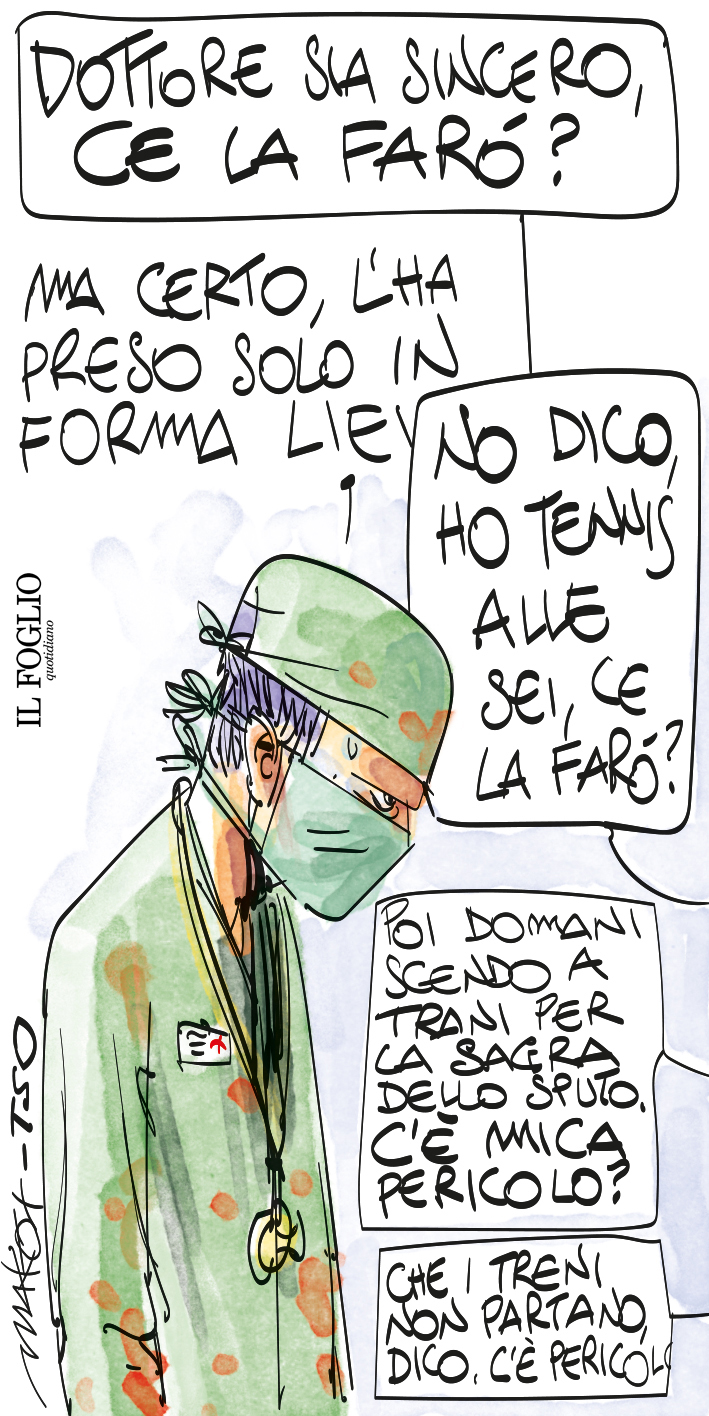
- Doctor, be honest, will I make it?

- but of course, you took it only in a mild form

- no, I mean, I have tennis at six o'clock, will I make it?
Then tomorrow I’ll go down to Trani for the spitting festival. Could it be dangerous?
that the trains do not leave, I say, is there any danger?


MAKKOX - COMPULSORY HEALTH CARE TREATMENT


I have the author's permission 
to devastate his work.
if someone  feel the urge to help 
is welcome (very)...